About Me

My photo
United States
I am a M.A. in industrial/organizational psychology. Most of my experience has been in human resources and change management. My passion lies in employee assessment, organizational development and employee opinions. Website: www.IanMondrow.com LinkedIn Profile: http://linkd.in/drBYoC

Monday, August 1, 2011

Harming High Performers: a Social Comparison Perspective on Interpersonal Harming in Work Teams

Summary and Commentary by Ian B. Mondrow, M.A.


Interpersonal harming within the work environment is behavior that contradicts the interests of another person within the organization. These type of behaviors can include disturbing others while they are working, starting arguments, and gossiping about coworkers. Social comparisons (comparing one's performance to another individuals as either better or worse) may be cause of interpersonal harming. A upward comparison is when an individual views him/herself as better than others and is self-affirming. A downward comparison (viewing oneself as inferior to another) may be perceived as threatening and therefore the individual may compensate by doing emotional harm to others. When a downward comparison is negative, conducting interpersonal harm may negatively affect the target's job performance and therefore reduce any threats perceived by the harmer.

Two independent studies were conducted, one with student teams from a university and another with work teams within a corporation. Study 1 collected data from students at a university in Macau, China with a final data set of 141 students and 30 teams. Students were working in teams of three to seven to complete a group project. Data was collected at two different time periods. Time 1 occured 1.5 month after the team has been working together and Time 2 was conducted one month later.Study 2 collected data from sales associates in a state-owned telecommunications company in China. Teams consisted of four to five members. All members in the team were of the similar seniority. The final data set included 128 individuals from 31 teams.

Two items from Lockwood et. al. (2002) were used to measure  interpersonal social comparisons. Respondents were also asked to compare their performance to their team members on a 9 point scale. Respondents were then asked "how likely is it that you will perform like this member?" This question was also measured on a 9 point scale.  Three items from Tjosvold et. al. (2004) were used to assessed cooperative goals within the team based on a 5 point scale. Interpersonal harming  was measured using peer ratings developed by Cohen-Charash & Muelle (2007), which distinguishes between six types of harmful behaviors. In study 2, supervisors were asked to evaluate each team's performance.

Researchers found a three-way interaction between social comparison, anticipated future performance, an cooperative team goals with statistical significance in Study 1 (B = .07, p<.01) and Study 2 (B = .06, p<.001). This suggests that teams with less cooperative goals and an individual exhibiting a upward comparison was positively related to the possibility harming a target when the expected future performance was considered low to the target.  However, when expected future performance was high, there was no relationship to social comparison. Furthermore, when highly cooperative team goals were established,  then there was no relationship with interpersonal harming and/or social comparison.

Results revealed that harmful behavior was positively correlated with upward comparison and negatively related to expected future performance. However, these results were only applicable to Study 1 and not Study 2. In both studies, it was found that interpersonal harming and cooperative team goals were negatively correlated. Results continued to show that team members were more likely to to harm others when there was an upward performance comparison accompanied with low expectations of future performance.

Results of this study suggest that establishing team goals is crucial to reduce the likelihood of toxic behaviors occurring. When goals are not established or agreed, individuals are more likely to compare themselves to others and possibly cause interpersonal harm. Therefore, to increase the chance of team success, teams should establish goals from the start and ensure that everyone agrees with them. This will reduce the possibility of team members comparing themselves to one another and instead create a sense of community, in which the perceived success of the individual depends on the success of the team.

The study has several apparent limitations. First, it was studied in China and therefore may not be applicable to all cultures. Future studies should examine multiple cultures to determine if it can be considered a variable. Second, the sample n Study 2 was only from one organization within a specific industry. This makes it difficult to generalize to the population. In future research, the researchers should be sure to include several companies of different industries to ensure it can be generalized to the public.

IMPLICATIONS FOR HR PROFESSIONALS
For organizations that require employees to work in teams (i.e. consulting, marketing, etc.), this study brings some valuable perspective. It suggests that by establishing cooperative team goals, it can create a positive dynamic between team members and encourage them to work as one.

Therefore,  there are several things that can be done to encourage success among teams. When teams are about to start projects, the project lead should hold a "kick off session". Within this session, the lead explains the project and what the work will entail. Then the team can work together to establish goals that can be applied to the project. Most often, the project lead will establish the goals without consulting with the the team members. In this case, team members feel as if they have no voice and are more likely to create a competitive environment. When goals are established and agreed by everyone on the team, it creates a sense of unity that can be reinforced throughout the project.

How can human resources professionals encourage this practice? Its rather simple. HR professionals can hold a one hour training session for project leads on how to establish team goals and how to facilitate the brainstorming process. Project leaders should be educated on the benefits of this practice and provided tools that can help them facilitate a goal-setting session with their team. If these individuals are not provided with training, there is a greater chance that they will create the goals independently or not even bother to establish goals.

Overall, success within teams thrives on establishing the message that the teams success means success for all team members. An individual can not be successful independently unless the team succeeds as well.


Work Cited
Lam, C.K., Van der Vegt, G.S., Walter, F., and Huang, X. (2010). Harming high performers: a social comparison perspective on interpersonal harming in work teams. Journal of applied psychology, 96 (3), 588-601.

Saturday, July 9, 2011

Managing the Inner Contractions of Job Descriptions: A Technique for Recruitment

Summary and commentary by: Ian Mondrow, M.A. in Industrial/Organizational Psychology

A job description is a document composes of several sections, including: job title, supervisor title, job responsibilities, and qualifications for hiring. This single document is sole resource for many organizational operations such as recruitment, performance review, training/development, organizational structure, and more. However, Stybel (2010) claims that job descriptions are merely intended for audiences within the organization. However, issues occur because job descriptions are also used for external and internal job postings. Such that, job descriptions are written to be "public" friendly and do not always obtain the most accurate information needed for the internal operations.

Stybel and Peabody (2007, as cited by Stybel, 2010) introduced a new section into the job description called the "Leadership Mandate". This new section communicates how an individual advances within the company's strategic plans. They now use 2 documents when conducting a candidate search: (1) a job description for the general public to attract candidates in applying and (2) a leadership mandate which is given to final candidates. Stybel (2010) claims that creating these two documents protects the company against fraud charges.

The leadership mandate is merely another section of the job description that is limited to specific audiences. This new section defines what changes the company expects within the 90-120 days, what responsibilities are considered critical/time-sensitive, which responsibilities are to be placed on the back-burner (not address immediately) for the next 4 months, what is to be avoided at all costs in the upcoming 90-120 days.

IMPLICATIONS FOR HR PROFESSIONALS
This article does emphasize the importance of job descriptions for both internal and external purposes. It provides the foundation on what tasks a specific job is responsible and what is considered successful in finishing this work. Every job within an organization should have a description. Using the same job for multiple positions produces a variety of risks for a company including: employee turnover [since the job was not what they thought], adverse impact [success factors are not consistent], inadequate opportunities for growth [because there is no defined career path], and more. Therefore, this articles emphasis on the value of job descriptions is extremely beneficial.

To be blunt, this idea of creating two documents is crap. While the notion of the leadership mandate and its content are good, the fact is that the information is not static. In January, the leadership mandate could be entirely different from the leadership mandate in May. Change occurs every day in an organization and therefore, creating such a document can be time-consuming and counter productive. Finally, creating such a document does not prevent fraud as a job description should include all responsibilities expected in a position.

On the contrary, it is the responsibility of the recruiter and the hiring manager to clearly communicate this content to candidates (which is emphasized more in the article title than article text). Creating a leadership mandate would be more beneficial to remind managers of what candidates need to be informed about. A leadership mandate is more suitable as a tool to help managers and not as a formal HR document.

It is crucial to emphasize the value of communicating the leadership mandate information to all job finalists. It will give them an accurate portrayal of what to expect in the months to come. This will reduce turnover and increase job satisfaction as the hired employee(s) will not be caught off guard. As HR professionals, we strive to ensure that applicants are satisfied in their jobs. This is one way to prevent any unexpected disappointments or dissatisfaction.


REFERENCES
Stylbel, L.J. (2010). Managing the inner contradictions of job descriptions:a technique for use in recruitment. The Psychologist-Manager Journal, 13, 105-110.


** I am not a lawyer or legal professional and therefore it is important to be aware of all state and Federal laws before considering implementation of any content read in this posting. I hold no liability for your actions. 

Monday, May 9, 2011

The Uniqueness Effect in Selection Interviews

Summary and Commentary by: Ian B. Mondrow, M.A.

It is a known factor that gender, physical appearance and race can influence an interviewers evaluation, whether intentional or unintentional. Studies have also shown that interviewers tend to prefer applicants that are similar to themselves. The contrast effects also impacts interviews where candidates are evaluated based on preceding interviews.  Roulin et.al. (2011) has decided to introduce a new bias called the "uniqueness effect".

The uniqueness effect was first introduced by Sndyer and Fromkin in 1977. Roulin et. al. (2011) has taken their definition and adapted it to personnel selection. Roulin et. al. define the uniqueness effect as "the effect of an applicant's distinctive characteristics or answers on recruiter's evaluations and decisions in the selection process (p.44)."

79 participants were recruited from a swiss university. 85% of the participants were masters students and 15% were senior bachelor students. Participants were asked to read one of two types of job descriptions, a creative position (marketing) and a less creative position (accounting). Following reviewing the descriptions, participants read four transcribed answers to interview questions. The transcriptions were obtained from four mock interviews from male job seekers. Questions included:

  1. Tell me about yourself
  2. What is your main weakness?
Question one included responses of equal values. Three applicants gave non-unique answers to question two and one provided a unique answer. After reviewing the Q&A, participants evaluated the answers based on quality, job-related competence and the likelihood of termination for each applicant on a 6 point likert scale. Participants were also asked to select one applicant to hire.


The researchers conducted a 2 X 2 X 2 factorial plan to analyze results using a within-subjects methodology. A main effect was present for uniqueness, F(1,75) = 8.94, p < .01, in which unique applicants were rated higher than (M = 4.25) than non-unique applicants (M = 3.81). Job type (creative vs. non-creative) also produced a main effect, F(1,75) = 10.0, p = .002, which creative jobs recieving lower evaluations (M = 3.81) than non-creative jobs (M = 4.14). Results compared unique candidates to non-unique candidates are demonstrated in Figure 1. Figure 2 demonstrates the hiring choice for unique applicants in job type.

Several limitations to the study are present. More specifically, all participants were students and therefore are more likely to place more emphasis on academic background than job qualifications. Furthermore, the study is limited to the swiss culture and therefore may not be applicable to all cultures. 

IMPLICATIONS FOR HR PROFESSIONALS
The study demonstrates that providing unique responses to an interview may increase one's attractiveness as an applicant. However, HR professionals must question if this a positive or negative. Uniqueness does ensure that the candidate is not providing a "cookie-cutter" answer but it also risk being less applicable to the job. Unique answers can be effectively evaluated by incorporating anchors into the interview. This assists managers is effectively evaluating the answers. It also ensures that unique answers are tracked and recorded for further debate. Furthermore, using anchors will reduce the likelihood of similarity effects or contrasts effects. 

Quality of an answer is far more predictive of performance instead of unique answers. Therefore, the downside of unique responses is that it may not be representative of the skills needed to be successful in the job. This once again reinforces the need for anchored responses. While a unique answer may be easily recalled, using anchors ensures that responses are scored based on the required knowledge, skills and abilities. 


Source: Roulin, N., Bangerter, A., Yerly, E. (2011). The uniqueness effect in selection interviewing. Journal of Personnel Psychology, 10 (1), 43-47.

Monday, April 18, 2011

Seeking Work-Life Balance: Employees' Requests, Supervisors' Responses and Organizational Barriers

Summary and Commentary by: Ian B. Mondrow, M.A.

Work-life balance has become a sensitive topic for many employees. Daily needs, such as child care and elder care, require a significant amount of time and technology (such as blackberries and e-mail) have made it difficult to "leave work at work. Previous research on this topic has focused on the consequences of work-family conflict and the benefits of successfully managing the two. The balance is also important to employers as successful work-life balance is positively correlated with job satisfaction, life satisfaction, productivity, and attendance. Lauzun, Morganson, Major and Green (2010) set out to examine work-life balance in the context of company policies and organizational support.


425 supervisors [from a Fortune 500 company producing consumer goods] were asked to respond to 5 questions for each employee supervised. A total of 1,150 requests were reported. Figure 1 elaborates on the type of employees evaluated. Supervisors were ask the following questions when an employee made a request for work-life balance:


  1. Please provide the specifics of each employee's request.
  2. Did you accommodate the request?
  3. If you answered YES, how did you accommodate the employee's request?
  4. If you answered NO, why did you not accommodate the request? (Lauzun et. al., 2010)
The results were analyzed using a deductive open-coding approach and a codebook was developed to identify reoccurring trends. Two coauthors examined the data with the codebook and a high level of interrater reliability was established. 


In total, 1,150 work-life requests were received from employees. 752 of these requests were accommodated and 326 provided reasons for not approving the requested. 72 responses did not include data from the supervisor or the researcher could not properly code the data. The most frequent type of request for schedule changes or time to be off-site (n = 523). There was a high demand for work schedule flexibility (n = 265). Some employees even asked for the possibility to telecommute (n = 46). 


The second most common type of request focused on an employee's daily workload (n = 33). Many individuals felt that a collection of their meetings were not a valuable use of time. Previous research has found that meeting frequency is linked to daily fatigue and subjective workload (Luong & Rogelerg, 2005 as cited in Lauzun et. al., 2010). There were also requests to improve operating procedures.


The third most reoccurring requests were for resources to better assist the work-life balance (n = 230). This could include technology or additional staffing needs. 

A collection of employees requested social support and emotional support that did not fit into the other themes (n = 64), such as emotional support, compensation or on-site amenities. 

Figure two demonstrates the frequencies for the amount of requests and their themes. 


When responding to the requests, 58% of supervisors accommodated employees that expressed interest in schedule changes (n = 523) or accommodations (n = 301). 81% of requests for work resources were also approved, with 230 requests for resources and 186 accommodations. Solutions included coaching, training, increased/reallocation of staff and additional tools/equipment. 333 requests were made to change one's daily work but only 46% (n = 146) were approved. For an overview of results, please refer to Figure 3.

When examining requests for emotional and instrumental support, 119 accommodations were made when there were only 64 requests. Several reasons were identified for this difference: (1) supervisor communicated with employees when work/life balance requests were made and (2) supervisors provided support when they were unable to satisfy requests in an instrumental matter. 


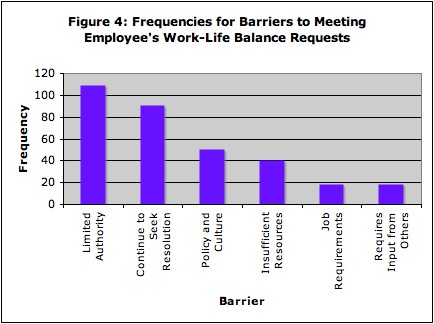
Further analysis of the data revealed several barriers that overpowered a supervisors ability to grant requests. A total of 326 were identified and sorted into 6 categories: authority, seeking resolution, policy/culture, insufficient resources, job requirements, and multiple involvement. 109 requests were denied because the supervisor lacked the authority to authorize the request. It was also found that 40 requests were not approved because the appropriate staffing or funding was not available (Resources). Several requests were denied because of organizational policy or norms (n = 18) and and others were denied because the job requirements (n = 18) forbid such a requests. Supervisors were unable to approve all the requests and some needed the involvement of other parties (n = 18). Although many requests were denied, there were 91 instances where a supervisor continued to pursue the request for his/her employee. Pleasure refer to Figure 4 for a visual layout of the results.

This study produced several findings. Flexibility in work time and location seems to be the greatest in demand for work-life balance. Telecommuting can also benefit employers as it can reduce building and maintenance costs. It was also found that adjusting work responsibilities and providing additional resources could assist in work-life balance.

A variety of limitations exist in this study. First and foremost, the study was based upon self-report data and therefore the data is vulnerable to recall bias. Additionally, subordinates may be hesitant to make requests to their supervisor in fear of negative consequences. Another vital limitation is that the study focused on one organization and therefore cannot be applied to the population.

IMPLICATIONS FOR HUMAN RESOURCES
As one of the few qualitative studies to examine work-life balance, this study produces some interesting findings. However, it also suggests valuable information for human resources. One key point is that human resources professionals should empower managers to control the schedules of their employees. There should be no need for managers to obtain input from others or to seek alternative resolutions. This can discourage employees from making future requests and create anxiety as they wait to hear if their request is approved. Supervisors should have a general understanding of the needs of their departments and thus have no need to check with others. If this were my company, I would likely investigate why input is needed from others. It is possible that this manager needs assistance in managing resources.

Flex-time was identified as one of the most common requests among employees. Given today's technology and globalization, it is sometimes in a company's best interest to allow employees to telecommute. As mentioned by the researchers, it can reduce costs of upkeep and properties. It also makes it easier to find the most suitable candidates for open positions, as a company does not need to limit their search to local candidates. There are incidents when telecommuting is not possible or it does not align with the company culture. A company must weigh the benefits and draw-backs to determine if telecommuting is compatible with the organization's needs.

It is reassuring to see that managers are likely to provide emotional support when requests are not approved. However, managers should always be emotionally supportive of their team. Support fosters trust, and an employee that trusts his/her manager is more likely to be committed to the job. Managers do not need to be best friends with their employees but they should be able to talk to employees when they notice unusual behavior. For instance, after taking a call, my co-worker becomes immediately withdrawn. After noticing this, my managers takes her to the parking lot to talk. She later hands her the keys and says,"if you need to go home, I will understand". That is support and it strengthened the relationship between my coworker and my manager. Heck! It made me view my manager in a whole different light!


Source: Lauzun, H.M., Morganson, V.J., Major, D.A., & Green, A.P. (2010). Seeking work-life balance: Employees' requests, supervisors' responses, and organizational barriers. The Psychologist-Manager Journal, 13 (3), 184-205.

Wednesday, April 6, 2011

Can personal control over the physical environment ease distractions in office workplaces?

Summary and commentary by Ian B. Mondrow, M.A.

Personal control is defined as the perceived control an individual has over various characteristics of his/her environment, which includes: (1) the organization of one's workspace; (2) personalizing one's workspace; (3) control over social contact; and (4) control over temperature, lighting and the work process (Lee & Brand, 2009). Distraction is the extent to which an individual feels diverted, disturbed or annoyed by an unwanted stimulus in the work environment.

Little consensus has been achieved on  on control in the workplace, therefore much of the information was obtained from previous studies to create the control construct for this study. 9 items were developed to measure control using a 7-point likeart scale. Statements were collected from a previous study conducted by Weisman (1986) which measured concentration and noise level. 8 statements were extracted and utilized a 7-point likeart scale. Finally, one's judgement on his/her performance was collected based on Oldham's (1988) aspects of quality, quantity and creativity. These items were scored on a 5-point scale.

A sample population was collected utilizing three manufacturing companies based in Michigan. A total of 384 surveys were analyzed. Information about the physical aspect of each building was also collected, including, year constructed, facility size, renovation history, distribution method of HVAC systems and workspace specifications.

Demographics include the following:

  • 62% male; 38% female
  • 28% worked in engineering; 12.8% worked in marketing; 58% were employed in engineer/technical/ professional positions; 24% were managers; 13% were clerical/support and 4.2% considered themselves as other
  • 74% worked in an open office  with high dividers
  • Office type varied based on job category (i.e. clerical personnel were more likely to work in a cubicle and a professional is more likely to have an office
The analysis methodology was unclear and questionable. It is possible that I may not have a background in this methodology but there was no p-value to designate the significance of the results. However, the authors state that perceived control over the physical environment environment mediated the negative effects of distraction on one's performance.  Therefore, the negative effects of distracting noise can be decreased by providing employee's control of their personal work place. 

Results need to be interpreted delicately as they were collected based on self-report. Clearly self-report surveys are vulnerable to biases. 

IMPLICATIONS FOR HR PROFESSIONALS
While the topic requires further research, it does reveal some helpful information. First and foremost, private offices are the ideal workspace for any employee, as it dramatically reduces the possibility of distractions. However, private offices for every individual employee is not always feasible and therefore, companies often resort to a public work environment.

When a public work environment is needed, employers should try to eliminate distractions as much as possible. One popular method is to use cubicle walls to provide employees with privacy. Some companies choose to avoid cubicles due to the stigma it can create. Even with cubicles, distractions, such as noise, are impossible to avoid. This article suggest increasing an employee's sense of personal control can assist them in blocking external distractions. Simple yet effective methods can be used, such as: 
Believe it or not, it is possible to get cubicles with doors
  • Instead of using overhead fluorescent lights, give employees lamps with a dimming feature
  • Allow employees to layout furniture
  • Encourage employee's to decorate their desk with pictures of their liking
  • Allow employees to which desk they want to sit at (if possible)
  • Enclose a cubicle and give employees the right to have a door


Source: Lee, S.Y., & Brand, J.L. (2010). Can personal control over the physical environment ease distractions in office workplaces? Ergonomics, 53 (3), 324-335.

Monday, March 21, 2011

Resume or curriculum vitae?

Summary and commentary by Ian Mondrow


Throughout my career, I have met people of different backgrounds. Some people have doctorates, others have been working for fifth-teen years and some people are just entering the job market. It was not until I applied for my friend's former position, that I realized some people use curriculum vitae (CV) instead of a resume. I decided to investigate this methodology further by asking my HR and recruiter friends. 


A survey was developed using Google docs and participants were obtained via LinkedIn and LinkedIn. In total, 12 participants completed the survey. Of these participants, 4 of them were human resources professionals, 4 worked in the recruitment industry, 3 were company owners and 1 person identified themselves as other. All participants were asked to rank a collection of statements based on a 5-point likert scale of agreement (1 = disagree and 5 = agree). Below are the following statements that were assessed:


  1. A resume should only be one page.
  2. A curriculum vitae works just as well as a resume.
  3. A curriculum vitae is best suitable for a PhD or PhD ABD.
  4. An individual with a graduate degree can have a resume that is more than one page.
  5. A resume can be more than one page if a candidate has enough job experience.
  6. A curriculum vitae is only applicable for jobs in academics.
  7. A curriculum vitae is only applicable for jobs in research.
  8. Bachelor graduates should not use a curriculum vitae.
  9. A resume is far more effective than a curriculum vitae.
  10. Recent graduates should apply for jobs with a curriculum vitae.
RESULTS
Figure 1: A resume should only be one page
Questions 1, 4, and 5 questioned respondents on the lengths of resumes and their preferences. Contrary to the teachings of many career centers, 10 out of 12 respondents disagreed that resumes should only be one page. Furthermore, no respondents agreed with that statement. Figure one demonstrates these results in a bar graph. Questions 4 and 5 continue by asking if there are exceptions to the 1 page standard. 9 out of 12 respondents agreed that it is more acceptable for individuals with advanced degrees (i.e. Masters, PhD, etc.). Moreover, all participants agreed that it is acceptable to have more than one page if an individual has enough job experience. Figure 2 demonstrates their agreement in a bar graph. 


Items 2,3 and 6-10 focused on the usage of a CV instead of a resume. As expected, most participants agreed that a CV is best for candidates with a PhD, at least according to 10 participants. It was expected that CVs would be preferred for academic or research jobs but there was no consistent pattern between participants. Please refer to figure 2 and 3 for a representation of these results. Surprisingly, no one completely agreed with statements 6 and 7. The usage of the word "only" in these statements may have impacted the results.


Figure 2: A CV is only applicable for jobs in academics

Figure 3: A CV is only applicable for jobs in research
Results continued to shock as no participants showed any agreement to item 10, which states that graduates should use a CV. In general, there was no preference between a CV or a resume.


CONCLUSIONS
In general, one's job experience seems to be the determining factor of resume length. If an individual has enough experience to fill more than one page, it is more acceptable to include 2 pages if the content consumes at least half of the second page. One respondent mentioned that recruiters won't read 2 pages but all participants agreed that having a 2 page resume can be beneficial if it contains significant accomplishments and relevant information. 


The only exception to that rule is if an individual utilizes a CV. CVs are generally longer in length. Using a CV instead of a resume appears to be personal preference and hiring managers have their preference as well.  When participants were asked if they prefer a CV or a resume, most of them responded that it varied on the market and the job. Therefore, job applicants should conduct research to determine if a resume or CV would be more suitable. 


Figure 4: A CV is only applicable for jobs in academics
There are several limitations to this study. First and foremost, the participants are not a true representation of the population. This representation is difficult to achieve with only 12 people. Second, the size of the participant pool can drastically alter the results of a study. The fewer participants that participate, the more weight their market has. 


Thank you for all those who have participated!

Monday, March 14, 2011

Can Counterproductive Work Behaviors Be Productive?

Summary and Commentary by: Ian B. Mondrow , M.A.

Counterproductive work behaviors (CWB) are acts consciously conducted by employees that have the ability to negatively impact an organization and/or its members. Spector et al. (2006) has suggested that there are five categories of CWBs including: abuse towards others, sabotage, theft, production deviance (i.e. working slowly), and withdrawal (i.e. taking longer breaks). CWBs may be a result of emotional exhaustion, or the feeling of being worn down as a result; often the result of burnout.  Emotional exhaustion has been found to be  related with turnover, cardiovascular and sleep problems, decreased motivation, decreased task performance, and citizenship behaviors.

It has been suggested that CWBs  are a coping mechanism to reduce stress from a negative situation. Coping is a cognitive or behavior action that one takes in response to stress. CWBs provide individuals with a sense of control over stressful situations. This article focuses on withdrawal and production deviance. Withdrawal and production deviance reduce employee exhaustion by giving individuals the opportunity to return to their normal emotional state. Withdrawal behaviors include actions such as taking longer breaks or leaving early for the day. While outside of the work environment, an employee's frustration decreases and allows an him/her to return to a calm state of mind. Production deviance is when an individual intentionally works slowly, does work incorrectly [intentionally],  or ignores procedures. These actions allow the individuals to "even the score" when confronted with injustice and may reduce emotional exhaustion.


Organizational justice is the how an individual perceives the fairness between individuals and the organization. It is composed of distributive justice and procedural justice.  Distributive justice is the perceived fairness of reward and recognition, while procedural justice refers to the fairness of the process by which decisions are made. Organizational justice may have the ability to influence the occurrence of CWBs within an organization.


Krischer, Penney and Hunter (2010) utilized StudyResponse Project to recruit 522 participants; of which, 295 were examined. Although it was requested that participants be employed full-time, 20.8% of the respondents were employed part-time. After careful analysis, it was determined the two groups were not significantly different. Participants completed a self-evaluation of the following:
  1. Price & Mueller's (1986) six-item scale to measure distributive justice (1 = very unfairly; 5 = very fairly)
  2. Moorman's 12-item scale to measure procedural justice (1 = strongly disagree; 5 = strongly agree)
  3. 3 items from the Counterproductive Work Behavior Checklist (Spector et. al, 2006) to measure production deviance (1 = never; 5 = everyday)
  4. 4 items from the Counterproductive Work Behavior Checklist to measure withdrawal  (1 = never; 5 = everyday)
  5. 6 items from the Job-Related Affective Well-Being (JAWS) Scale to measure emotional exhaustion (1 = never; 5 = always)
JAWS is not typically used to measure emotional exhaustion but 2 subject-matter experts identified items that closely relate to the definition of emotional exhaustion.

Results were collected by conducting intercorrelations and descriptive statistics. It was found that both distributive justice (rs = -.38, p < .01) and procedural justice (rs = -.41, p < .01) had a moderately negative correlation with emotional exhaustion. This suggests that if an individual perceives an organization to have low distributive justice or low procedural justice, he/she is more likely to be emotionally exhausted.

A hierarchical linear regression was also utilized to analyze the two types of justice, withdrawal, and production deviance. A strong interaction was found between distributive justice and withdrawal behaviors, R2 = .60, p < .01. It may be assumed that if an individual feels rewards are not fairly distributed, then he/she is more likely to withdraw. Distributive justice and production deviance also produced moderately significant results,R2 = .50, p<.05, suggesting that if distributive justice is perceived as high, one is less likely to conduct production deviance acts. Finally, procedural justice also had a moderate relationship with withdrawal, R2 = .42, p < .05, suggesting that withdrawal is less likely to occur when an individual feel procedural justice is served. No interaction was present between procedural justice and production deviance.

No significant findings were present when an individual admitted to high levels of production deviance. However, those who had low levels of production deviance had a negative relationship with between distributive justice and emotional exhaustion, r = -1.17, p < .01. Results continued to show that Individuals with low levels of withdrawal were more likely to be emotionally exhausted when they perceived procedural justice as low, r = -1.37 & -1.06, p <.01).

SUMMARY WITHOUT ALL THE STATS
Results show that if employee perceive their workplace to have higher levels of  justice, it will increase their well-being and reduce the need for coping behaviors. However, when justice is seen as low,  employees are more likely to exhibit CWBs as a coping mechanism . The researchers suggest that CWBs may be used to shape an employees emotional experiences at work, rather than a reaction to experiences.

Contrary to the researchers' hypothesis, the results showed that production deviance is not a coping mechanism for perceived procedural justice. Instead, it may be suggested that production deviance requires active engagement and therefore requires low levels of withdrawal to uphold, whereas withdrawal behaviors are far more passive.

IMPLICATIONS FOR HR PROFESSIONALS
The following study demonstrates the importance of organizational justice. Employees that perceive unfair organizational justice are more likely to withdrawal and be less interested or committed to their work. HR professionals can use their symptoms to their advantage. If employees  are observed exhibiting withdrawal behaviors (i.e. leaving early regularly, taking longer breaks, taking extra breaks, etc.), HR can begin to question both procedural and distributive justice within the organization. If this is an area of concern, surveys can be used to effectively measure personnel's perception of organizational justice. It is suggested to utilize a consultant with a background in industrial/organizational psychology or psychometrics to ensure that the survey is accurately measuring perceptions. 

HR can also use these findings to their advantage. CWBs can be prevented by ensuring employees are empowered. This can be succeeded through a fair grievance system or implementing a skip-level reporting system. Furthermore, emotional exhaustion can be prevented by providing employees with outlets for their stressors such as exercise programs or facilities. Organizations should also encourage employees to take break to ensure they can take time to restore their energy. 

The study also reveals scary findings. Employees that are likely to conduct production deviance are less likely to appear emotionally exhausted or withdrawn. This makes it far more difficult to identify employees that may be conducting counterproductive behaviors. In reality, it means that an engaged and supportive group of employees could contain an individual that exhibits negative behaviors. It is up to management to properly observe their employees and to measure performance on a regular basis. It is best to be proactive than reactive. Therefore, encourage employees to speak up when they observe deviant behaviors. 


Source: Krischer, M.M., Penney, L.M., & Hunt, E.M. (2010). Can counterproductive workbehaviors be productive? CWB as emotion-focused coping. Journal of Occupational Health Psychology, 15(2), 154-166.